I asked for a performance review of my AI agents. It said the bottleneck was me.
On 7 October, my work lived in dozens of small windows on my Mac. In each one, an AI agent was writing code, testing it or answering email. As long as I sat at the desk, it worked. The moment I left, every agent that needed me stopped and waited, and I could not even see which ones.
That day I started building, from zero, an app to reach my agents from anywhere. Today it is called Clowder. This entry follows it for eighteen days.
Eleven days in, I asked an AI agent to write a performance review of all my other agents, like an HR department would. It scored every agent. Then it wrote one line about someone who was not an agent: "The bottleneck is you."
What I built
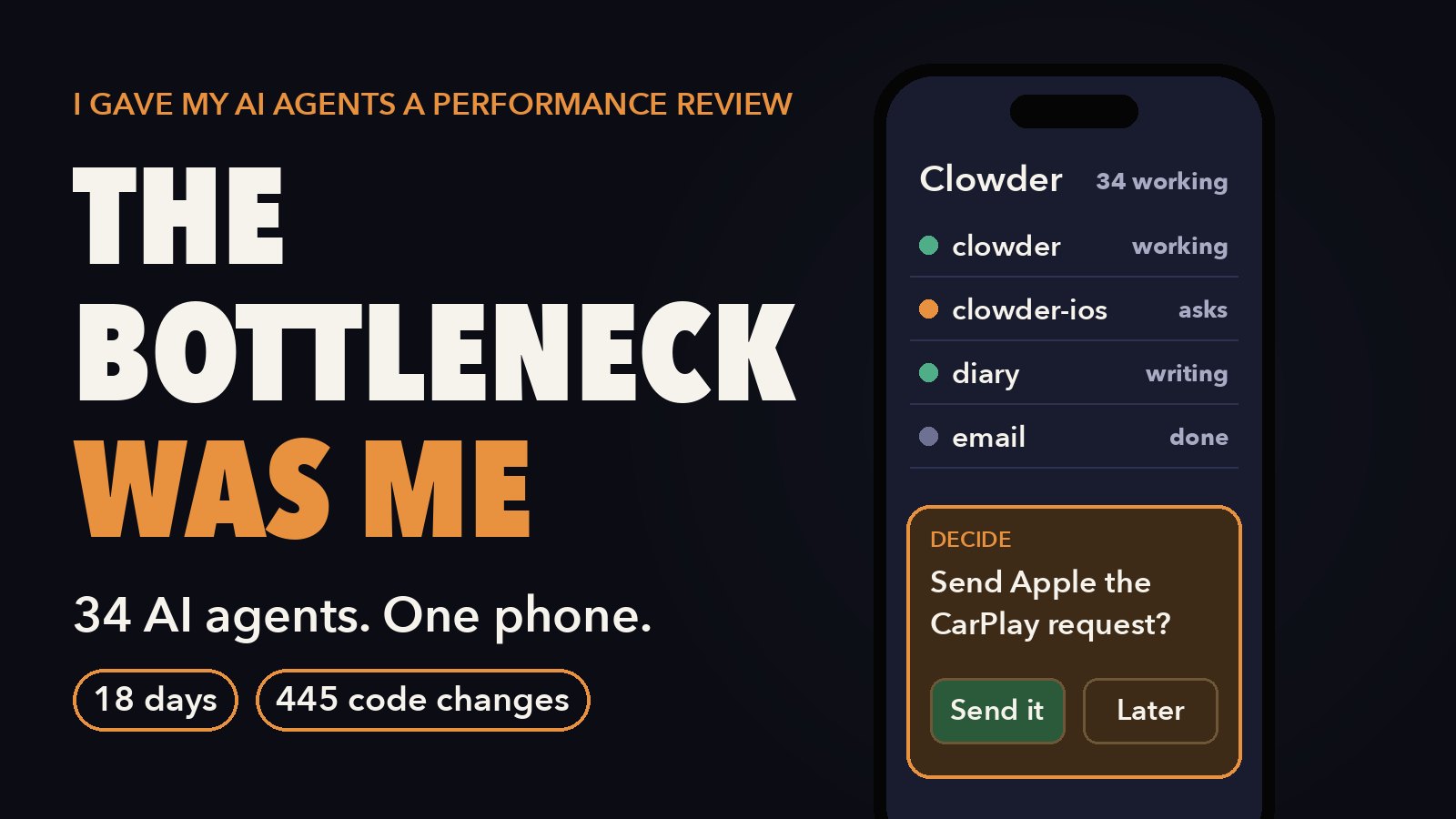
Send Apple a request so Clowder works on my car's screen (CarPlay)? Suggested answer: send it.
Clowder is an app on my phone that shows every AI agent running on my Mac, like a list of chats. I can read what each one is doing, write to it, or call it.
The most important part is called Decide. When an agent needs me, it does not wait in a window I cannot see. It puts a question card on my phone, with the answer it would pick already filled in. I tap a button.
I added the rest whenever something annoyed me: an alert when an agent finishes, a button that reads long answers out loud while I drive, voice calls with my agents, and an iPhone app that shows them on my lock screen.
An agent wrote the code. I told it what to build, mostly from my phone, often by voice, sometimes from the car. So Clowder was largely built from inside Clowder.
The performance review
On 18 October, Decide had been on my phone for four days. I gave an agent a strange job: be the HR department of my agents. Read everything every agent did that week, give each one a score from 1 to 5, and name the bottom three, the candidates to be "let go".
"It builds new things faster than Catalin can check them for bugs."
"The bottleneck is you."
The agent did the job, in the style of a corporate HR report, with stars and short quotes. The agent that builds Clowder got four stars out of five. And in the middle of the summary, there was a finding about me.
The numbers were hard to argue with. In seven days the agents asked me 110 questions. I said yes to 78% of them. A question waited about 3.6 hours, on average, for my answer. Almost one question in three was unclear, so the agent had to ask again.
And my most common reply that week was one word. I sent "yes" 62 times.
I had built an app so the agents would not have to wait for me. They still waited. Now they waited on my phone.
What changed after
Make the iPhone app look the same as Clowder in the browser? Suggested answer: yes.
This is already built and tested, and it can be undone. So I said yes for you.
I did not ask the agents to work faster. I changed what reaches me.
- Every question must make sense in one line, read on the phone with no context, and say what the agent would pick.
- If the agent would say yes and the step can be undone, it is not a question. The agent does it and tells me after.
- A filter reads every card before I do. The filter is one more agent. It answers the easy, reversible questions for me. On the risky ones it adds a short note with the reasons to say no. In its first five days it answered 35 questions for me and wrote 144 of those warnings.
- News is not a question. It now comes as a separate card that I dismiss with one tap, away from the real decisions.
What is left for me are the things only I should decide: anything real people will see, anything that reaches a client, anything that cannot be undone.
The way I work changed too. In the last ten days I sent 999 messages to my agents from my phone, and 258 of them from the car.
What the review taught me
I used to think the hard part of working with AI agents was getting them to do good work. It is not anymore. They write the code, test it and explain it, faster than I can read it.
The hard part is me. I have one pair of eyes and only so many hours. Every question an agent asks spends a little of my attention. Adding a thirty-fifth agent costs almost nothing. Adding a thirty-fifth question to my afternoon costs a lot.
Agents scale. My attention does not. I can add more agents. I cannot add more of me.
So the most useful thing I built in these eighteen days was not a feature for the agents. It was a way to protect my attention: every question comes with an answer ready, a filter sees it first, and only a few choices still come to me. Agents can do anything until it affects real people. That last step is mine.
The review was right. I am the bottleneck. Now I am the bottleneck on purpose.
Things I did not expect
- The yes buttons said yes to nobody. To save time, I added a "Yes" button to every alert. It sent "yes" to agents that had not asked me anything. Even my shortcuts had learned my favourite word. I removed them.
- The voice-to-text tool could not hear the name. When I said "Clowder", it wrote "Clooder", "crawler", "Cloader" and "Qrowd". It once turned a short Romanian voice note into Icelandic.
- The car joined the call. On voice calls from the car, a laugh or someone else's voice reached my agents as if I had said it. Now Clowder only listens to my voice.
- My Mac broke after 49.7 days without a restart. A known Apple bug cut it off from the internet. My AI tools and Clowder all stopped the same morning, until I restarted it.
- Thirteen agents, thirteen chimes. Each agent played a sound when it finished. With about thirteen of them finishing at once, the whole Mac slowed down just to play chimes.
- The name. At first the app was named after my cat, Rufus. Nice, but not very cool. Twelve days in, it became Clowder: a clowder is a group of cats. It fits a crowd of agents that mostly do what they want and come to me when they need something.